Residential vs commercial cleaning profits is one of the most important comparisons for anyone starting or scaling a cleaning business. While both segments operate under the same broad industry, they differ significantly in pricing structure, profit margins, workload, risk, and growth potential. Understanding how profits actually work in residential and commercial cleaning helps you choose the right path based on your goals, budget, and long-term vision.
Understanding Residential Cleaning Profits
Residential cleaning focuses on private homes, apartments, and condos. Services typically include standard cleaning, deep cleaning, and move-in or move-out cleaning.
Profitability in residential cleaning is driven by higher per-visit pricing, recurring clients, and relatively low overhead when starting small.
Many residential cleaners charge flat rates ranging from $100 to $300 per visit depending on home size and service level.
Because jobs are shorter and require smaller teams, residential cleaning often produces strong profit margins, especially for solo operators.
Typical Residential Cleaning Profit Margins
Residential cleaning businesses commonly see net profit margins between 20% and 35% when well-managed.
Solo cleaners often experience even higher margins because they avoid payroll overhead.
Recurring weekly or biweekly clients improve margins by reducing cleaning time and lowering marketing costs.
However, income is capped by how many homes can be cleaned in a day.
Understanding Commercial Cleaning Profits
Commercial cleaning focuses on offices, retail spaces, medical facilities, schools, and other non-residential buildings.
Commercial contracts usually involve larger spaces, fixed schedules, and long-term agreements.
Prices are typically lower per square foot than residential cleaning, but jobs are larger and more consistent.
Commercial cleaning revenue often looks impressive on paper, but profit margins can be thinner.
Typical Commercial Cleaning Profit Margins
Commercial cleaning businesses often operate with net profit margins between 10% and 20%.
Large contracts generate steady cash flow but require staff, supervision, and compliance with contracts.
Margins improve with scale, efficiency, and optimized labor management.
Poorly priced contracts can quickly erode profits.
Key Profit Drivers in Residential Cleaning
Residential cleaning profits benefit from:
• Higher prices per hour or visit
• Direct client relationships
• Recurring service schedules
• Lower startup and equipment costs
• Flexible pricing adjustments
Because pricing is less contract-driven, residential cleaners can raise rates more easily as costs increase.
Key Profit Drivers in Commercial Cleaning
Commercial cleaning profits depend on:
• High-volume contracts
• Efficient labor scheduling
• Long-term agreements
• Strict cost control
• Standardized procedures
Success often comes from managing teams efficiently rather than performing cleaning personally.
Revenue vs Profit: A Common Misunderstanding
One of the biggest mistakes new cleaning business owners make is confusing revenue with profit.
A commercial cleaning contract worth $10,000 per month may only generate $1,500 in profit after payroll and expenses.
A residential cleaner earning $5,000 per month may keep $2,000 or more as profit.
Higher revenue does not always mean higher profit.
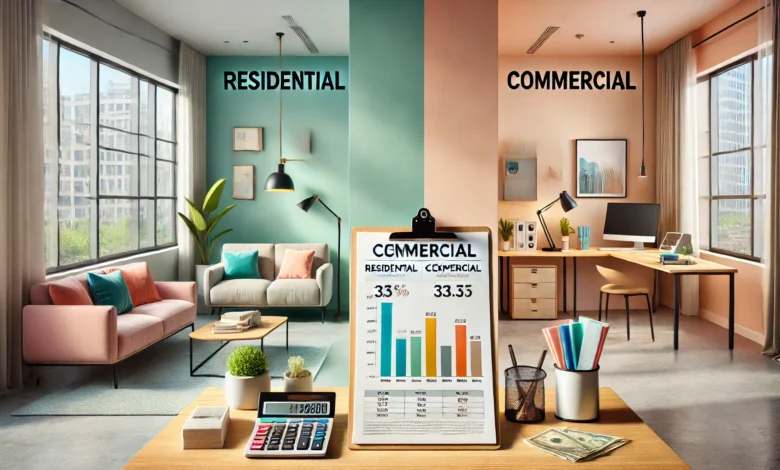
Residential vs Commercial Profit Comparison
| Category | Residential Cleaning | Commercial Cleaning |
|---|---|---|
| Average Profit Margin | 20% – 35% | 10% – 20% |
| Startup Cost | Low | Moderate to High |
| Client Volume | Many small clients | Fewer large clients |
| Cash Flow Stability | Moderate | High |
| Pricing Flexibility | High | Low |
| Scalability | Moderate | High |
Labor and Staffing Impact on Profits
Labor costs are the largest expense in both residential and commercial cleaning.
Residential cleaning often involves small teams or solo work, making labor easier to manage.
Commercial cleaning requires multiple employees, shift scheduling, training, and supervision.
Employee turnover can significantly affect commercial cleaning profits.
Risk and Responsibility Differences
Residential cleaning involves entering private homes, which requires trust and customer service.
Commercial cleaning involves contracts, service-level agreements, and penalties for missed work.
Commercial contracts often include strict insurance, bonding, and compliance requirements.
Higher responsibility does not always equal higher profit.
Which Model Is Better for New Businesses?
For most new cleaning businesses, residential cleaning is easier and more profitable to start with.
Lower startup costs, higher margins, and simpler operations make it beginner-friendly.
Commercial cleaning often makes more sense after building systems, staff, and cash reserves.
Can You Combine Residential and Commercial Cleaning?
Many successful cleaning companies operate in both markets.
Residential cleaning provides higher margins, while commercial cleaning offers stable contracts.
Balancing both can smooth cash flow and reduce risk.
However, mixing models requires strong scheduling and management.
Pros and Cons of Residential Cleaning Profits
Pros: Higher margins, flexible pricing, low startup costs, faster payments.
Cons: Income tied to labor hours, cancellations, seasonal demand.
Pros and Cons of Commercial Cleaning Profits
Pros: Long-term contracts, predictable revenue, scalable growth.
Cons: Lower margins, higher overhead, contract risk, staffing challenges.
Frequently Asked Questions
Is residential or commercial cleaning more profitable?
Residential cleaning usually has higher profit margins, while commercial cleaning offers higher total revenue.
Can commercial cleaning ever be more profitable?
Yes, at scale with efficient systems and strong management.
Which model grows faster?
Residential grows faster early, commercial grows faster long term.
Which is better for solo cleaners?
Residential cleaning is generally better for solo operators.
Conclusion
Residential vs commercial cleaning profits is not about which model is “better,” but which aligns with your goals. Residential cleaning offers higher margins, flexibility, and faster startup success, making it ideal for new or solo business owners.
Commercial cleaning provides steady contracts and scalability but requires stronger systems, staffing, and tighter cost control to stay profitable.
Many of the most successful cleaning companies start residential, build experience and cash flow, then expand into commercial cleaning strategically.
Understanding the true profit differences allows you to choose a path that supports both immediate income and long-term growth.